China Best Solid State Relay Overview and Key Insights?
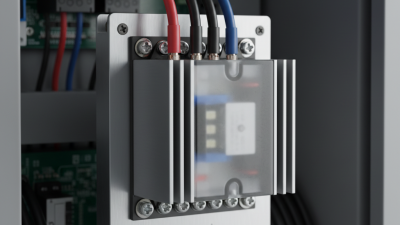
Solid State Relays (SSRs) have become essential in modern electronic systems. They offer advantages over traditional electromechanical relays. For instance, SSRs provide faster switching speeds and longer lifespans. This makes them a preferred choice in automation and control applications. The ability to handle high voltage and current without moving parts enhances durability. However, it's important to recognize that not all SSRs are equal in performance.
When exploring the best SSRs available in China, various factors come into play. Different manufacturers focus on unique features and applications. It can be challenging to determine which relay suits your specific needs. Some might excel in thermal performance while others offer superior load handling. User feedback is crucial in this decision-making process. The market is flooded with options, but standing out are companies that prioritize both innovation and reliability.
Furthermore, the transition from traditional relays to SSRs prompts important reflections. Users must consider trade-offs, such as cost versus reliability. While SSRs may initially seem more expensive, their long-term benefits often offset this. As technology continues to evolve, understanding the landscape of Solid State Relays in China is vital for efficient system design. Knowledge is power in selecting the right components for your projects.
China Solid State Relay Market Overview
The China solid state relay market is witnessing significant growth. Recent reports suggest the market value is projected to reach approximately $2 billion by 2025. This surge is propelled by increasing automation in various industrial sectors. Industries are seeking efficient, reliable, and compact solutions for electronic control systems.
China's adoption of solid state relays (SSRs) is notable. These devices offer faster switching speeds and enhanced durability. Their long lifespan also contributes to cost savings over time. However, challenges persist. End-users often face issues with heat dissipation and integration into existing systems. These hurdles can lead to inefficient energy use, requiring careful evaluation.
**Tip:** Consider thermal management when selecting SSRs for your application. Effective heat management can extend the longevity of your devices.
The market is diverse, with applications spanning from industrial controls to consumer electronics. This breadth illustrates the versatility of SSRs. Still, knowledge gaps exist among some users regarding optimal applications. This often leads to underutilization or misapplication of the technology. Businesses should invest in training and education to maximize their SSR benefits.
**Tip:** Engage with technical resources. Awareness of best practices can ensure you leverage SSRs effectively in your operations.
China Best Solid State Relay Overview and Key Insights
| Category |
Market Size (USD Million) |
Growth Rate (%) |
Key Applications |
| Industrial Automation |
400 |
7.2 |
Manufacturing, Robotics |
| Renewable Energy |
250 |
8.5 |
Solar Inverters, Wind Turbines |
| Consumer Electronics |
300 |
5.0 |
Home Appliances, Smart Devices |
| Telecommunications |
150 |
6.0 |
Network Equipment, Base Stations |
| Healthcare Equipment |
100 |
7.8 |
Medical Imaging, Diagnostics |
Key Features and Benefits of Solid State Relays
Solid state relays (SSRs) have become essential in modern electronic applications. They offer many advantages over traditional electromechanical relays. SSRs provide faster switching speeds, resulting in improved efficiency. They operate silently, which is beneficial in noise-sensitive environments.
One of the key features of SSRs is their durability. These components have no moving parts, reducing wear and tear. They are built to last longer, often performing up to millions of cycles without failure. However, heat dissipation can be a challenge, requiring proper management in design.
Another important benefit is their ability to handle a wide range of voltage and current ratings. This flexibility makes them suitable for various applications, from industrial automation to home electronics. Still, users must properly calculate loads to avoid overstress. Overall, while SSRs offer notable benefits, careful consideration of their limitations is vital for optimal performance.
Applications of Solid State Relays Across Industries
Solid State Relays (SSRs) have become essential components in various industries. They control power with excellent reliability and efficiency. According to a report by MarketsandMarkets, the SSR market is projected to grow from $1.5 billion in 2021 to $2.4 billion by 2026. This growth reflects their increasing use in automation and control applications.
One prominent application area is manufacturing. SSRs excel at managing high-voltage loads with minimal noise and heat. They are crucial in robotic arms and conveyor systems. These technologies demand precise control and durability. In the automotive sector, SSRs help manage electric systems, including LED lighting and battery management. A study indicates that more than 30% of automotive applications will incorporate SSR technology by 2025.
Despite their advantages, SSRs are not without challenges. Overheating can be an issue if not managed properly. Users often overlook heat sinks, which can lead to reduced lifespan. Additionally, while SSRs can switch rapidly, they may not handle all types of loads efficiently. This requires careful consideration in design. Finding balance is key. Understanding these complexities is vital for leveraging SSRs in modern applications.
Future Trends and Innovations in Solid State Relay Technology
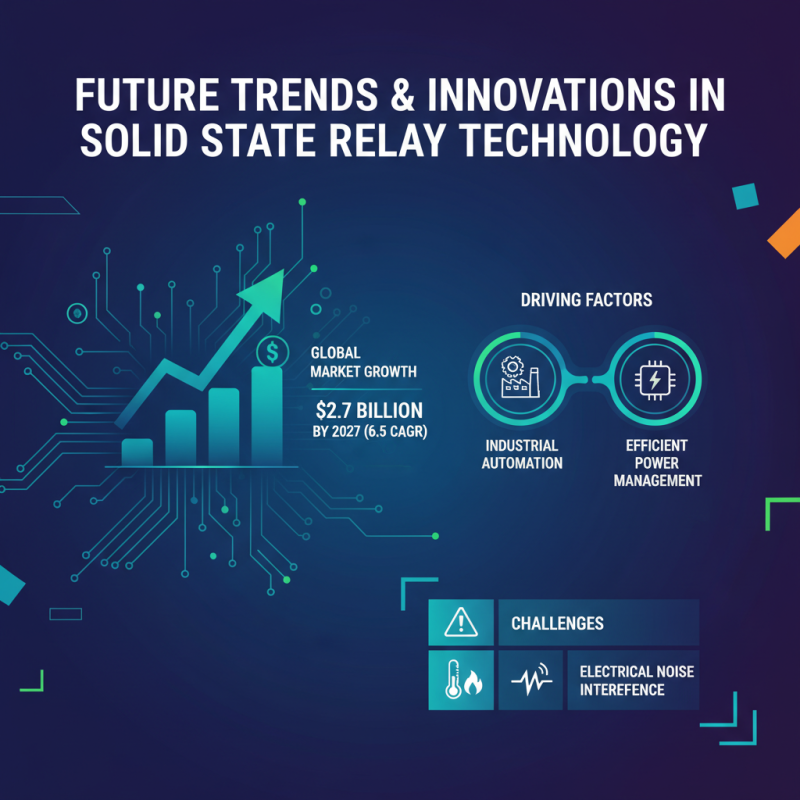
The field of solid state relay (SSR) technology is rapidly evolving. Recent reports indicate that the global SSR market is projected to reach $2.7 billion by 2027, growing at a CAGR of 6.5%. This growth is largely driven by increasing automation in industries and the demand for efficient power management solutions. However, there are challenges. The transition from traditional electromagnetic relays to SSRs is not seamless. Engineers must consider heat management and electrical noise interference.
Future trends indicate that advancements in semiconductor materials will play a crucial role. Wide bandgap semiconductors like silicon carbide (SiC) and gallium nitride (GaN) are expected to enhance performance significantly. These materials boast higher efficiency and thermal conductivity. Meanwhile, the integration of IoT into relay systems is on the rise. This integration allows for improved monitoring and control, though it raises concerns regarding cybersecurity.
As manufacturers innovate, the reliability of SSRs must not be compromised. There is a need for rigorous testing protocols to ensure longevity. A report highlighted that nearly 25% of failures in electronics can be attributed to thermal stress. Thus, while the future is bright for SSR technology, these critical points require careful attention. Industry players must balance innovation with reliability and efficiency to meet evolving demands.