How to Choose the Right IC SMPS Power Supply for Your Needs?
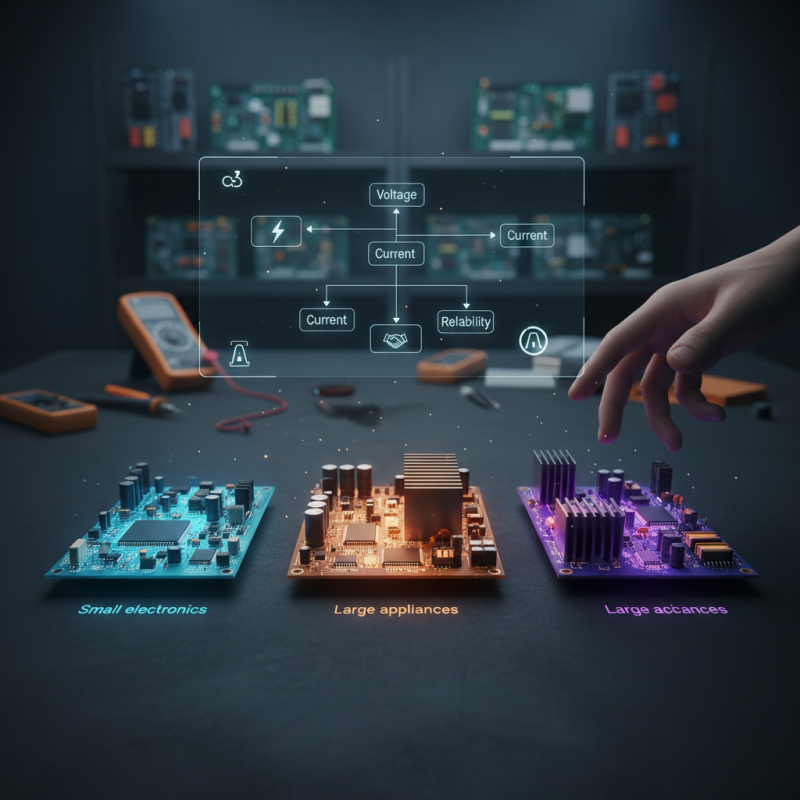
When it comes to selecting the right IC SMPS power supply, the choices can be overwhelming. You might face confusion with so many options available. Understanding your needs is crucial for making the best decision. An IC SMPS power supply can power everything from small electronics to large appliances.
Consider the voltage and current requirements of your project. Different applications demand different specifications. It is easy to underestimate the importance of these factors. A mismatch can lead to inefficiencies or even damage to your devices. Research is essential, but it can be challenging to find reliable information.
Additionally, think about the reliability of the supplier. Are they well-reviewed? Do they offer good support? Many users overlook these aspects, which may lead to regret later. Choosing an IC SMPS power supply isn't just about specifications; it's about ensuring smooth operation for your devices. Reflect on your current and future needs carefully.
Understanding the Basics of IC SMPS Power Supplies
IC SMPS power supplies are crucial in today's electronic devices. They convert AC to DC power efficiently. Understanding their basics can help you make informed choices. According to industry reports, the global SMPS market is projected to grow by 4% annually through 2027. This growth reflects the increasing demand for compact, lightweight power solutions.
Several factors influence the selection of an SMPS. Efficiency ratings are pivotal. A higher efficiency often results in lower heat output and energy costs. Reports indicate that consumers experience savings of 10% to 20% with highly efficient models. Additionally, understanding voltage and current requirements is vital. Failing to match these can lead to underperformance or device damage.
Consider the size and thermal management as well. Some designs may be compact but lack effective heat dissipation. Inadequate cooling can shorten the lifespan of components, causing reliability issues. It's essential to weigh these factors carefully. Remember, the right choice can enhance your project's efficiency and longevity.
How to Choose the Right IC SMPS Power Supply for Your Needs?
| Parameter |
Description |
Value/Example |
| Input Voltage Range |
The voltage range of the input power source |
85-265V AC |
| Output Voltage |
The voltage output required by the application |
12V DC |
| Output Current |
Maximum current the power supply can deliver |
2A |
| Efficiency |
Percentage of input power converted to output power |
>80% |
| Switching Frequency |
Frequency at which the power supply operates |
100 kHz |
| Protection Features |
Safety mechanisms to prevent damage under certain conditions |
Over-voltage, over-current, short-circuit protection |
| Footprint/Size |
Physical dimensions of the power supply |
5cm x 3cm x 2cm |
| Operating Temperature |
Temperature range within which the power supply operates safely |
-20°C to +70°C |
Identifying Your Power Requirements and Specifications
Identifying your power requirements is crucial when selecting an IC SMPS power supply. Start by assessing the total wattage your application needs. For example, a typical low-power device may require about 10-30 watts, while industrial applications might need several hundred watts. Consider peak and average loads. A device may require more power at startup compared to its running state.
Tip: Calculate your system's efficiency. An efficiency of 80-90% is common, but ensure you have headroom. This helps accommodate unexpected demand. It’s essential to use tools like power meters and load testers to help accurately gauge needs over various operating conditions.
Additionally, consider voltage and current specifications. Many applications require stable voltage levels, often within 5% of the nominal value. According to industry reports, such precision can significantly enhance device longevity. Implementing adequate filtering for noise and ripple is equally important.
Tip: Don't overlook thermal performance. Power supplies convert excess energy into heat. Poor thermal management can lead to failures. Design your setup to allow proper airflow and heat dissipation. This may involve rethinking your physical layout. Attention to these details will lead to better reliability and efficiency.
Evaluating Efficiency and Performance Factors
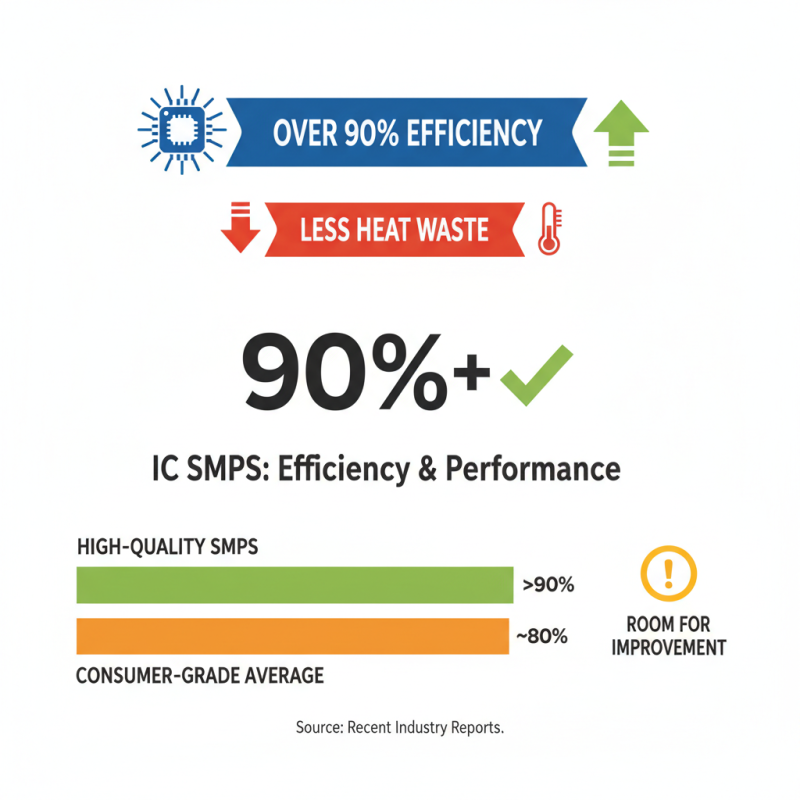
When selecting an IC SMPS (Switched-Mode Power Supply), efficiency and performance are crucial. Efficiency rates are often measured in percentages. For instance, a high-quality SMPS can achieve efficiencies over 90%. This means less energy wasted as heat, enhancing overall system performance. According to recent industry reports, the average efficiency of consumer-grade power supplies hovers around 80%, indicating substantial room for improvement.
Performance factors extend beyond efficiency ratings. Load regulation, ripple voltage, and transient response play significant roles. A well-regulated power supply can maintain stable output voltage under varying loads. Reports show that power supplies with poor load regulation can suffer from output fluctuations, affecting connected devices. Ripple voltage should ideally be reduced to less than 1% of the output voltage to ensure device safety and longevity. Many users overlook these aspects, focusing solely on efficiency.
In real-world applications, users sometimes encounter trade-offs. A supply with higher efficiency may cost more or require more complex designs. Not everyone considers the long-term savings from lower energy bills. Balancing efficiency and performance requires careful evaluation. Each application may have different requirements. A deeper understanding of these metrics can help users make informed decisions catering to their specific needs.
Comparing Different Types of IC SMPS Power Supplies
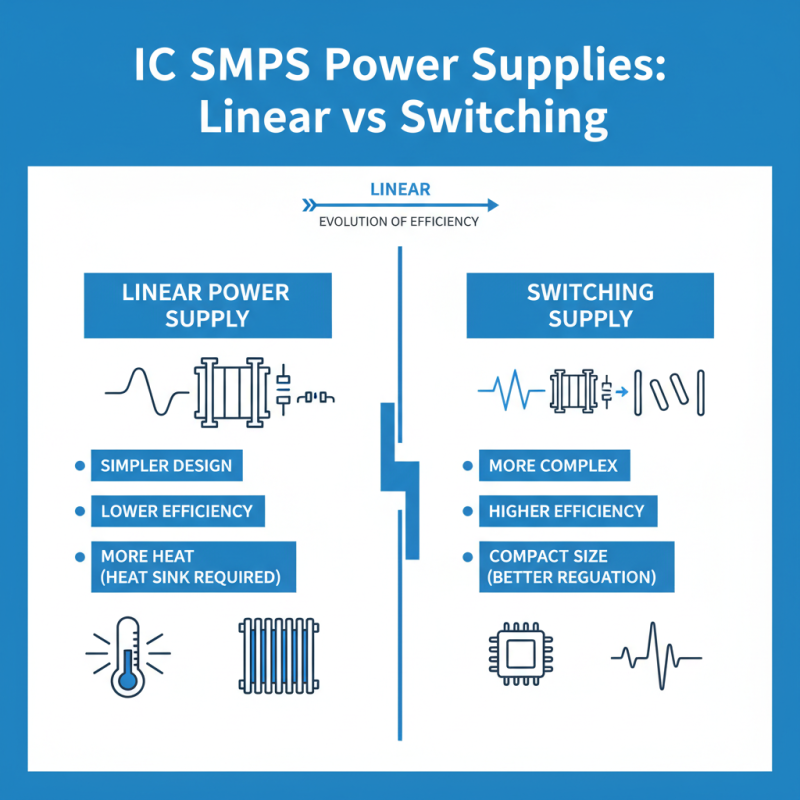
When choosing an IC SMPS power supply, it's essential to understand the different types available. There are linear and switching power supplies. Linear supplies are simpler but less efficient. They generate more heat, requiring good heat dissipation methods. Conversely, switching supplies are more efficient and compact. They can handle varying loads and provide better voltage regulation.
Tips: Always assess your load requirements. Know how much power you really need. Overrating components can lead to unnecessary costs.
Each supply type has unique features. For instance, isolated power supplies offer safety benefits, while non-isolated ones are more cost-effective. Pay attention to noise levels as well. Some applications need low-noise outputs. High-frequency noise can interfere with sensitive circuits.
Tips: Consider environmental conditions too. Extreme temperatures can affect performance. Dust and humidity can lead to failures. A well-chosen IC SMPS should meet your specific conditions for reliability.
Assessing Safety Standards and Compliance Needs
When selecting an IC SMPS power supply, safety standards should be a primary consideration. Compliance can affect not only device performance but also user safety. Different regions have specific safety standards. It's crucial to know which apply to your market. Research local regulations to ensure compliance.
Consider reviewing the safety certifications of potential power supplies. Look for marks from recognized bodies. These certifications signify adherence to safety benchmarks. For many applications, certifications may include UL, CE, or FCC. Not all products meet these benchmarks, and overlooking them can result in serious issues later.
Tips: Always verify if the power supply's design includes protection features. Over-voltage and over-current protections are vital. They can prevent catastrophic failures and ensure longevity. Evaluate whether the device's components are rated properly for your specific application. This can reveal flaws during your assessment. Take your time, as rushing could lead to costly mistakes.
Power Supply Efficiency Ratings