How to Choose the Right Photoelectric Sensor for Your Application?
Choosing the right photoelectric sensor can significantly impact your application’s efficiency. According to Dr. Laura Mason, an expert in sensor technology, “Understanding your specific needs is crucial when selecting a photoelectric sensor.” Her experience highlights the importance of tailoring the selection process to fit unique requirements.
Photoelectric sensors vary greatly in type and functionality. From proximity to retroreflective sensors, each has its advantages and drawbacks. For instance, a retroreflective sensor may excel in distance but could struggle with reflective surfaces. Assessing these characteristics is essential for optimal performance.
When considering a photoelectric sensor, one must also factor in the environment. Dust, moisture, and temperature variations can influence sensor effectiveness. Therefore, testing sensors in real-world conditions ensures reliability. Remember, even a well-chosen photoelectric sensor may not perform as expected without proper installation and configuration. This highlights the need for careful planning and reflection throughout the decision-making process.
Factors to Consider When Selecting a Photoelectric Sensor
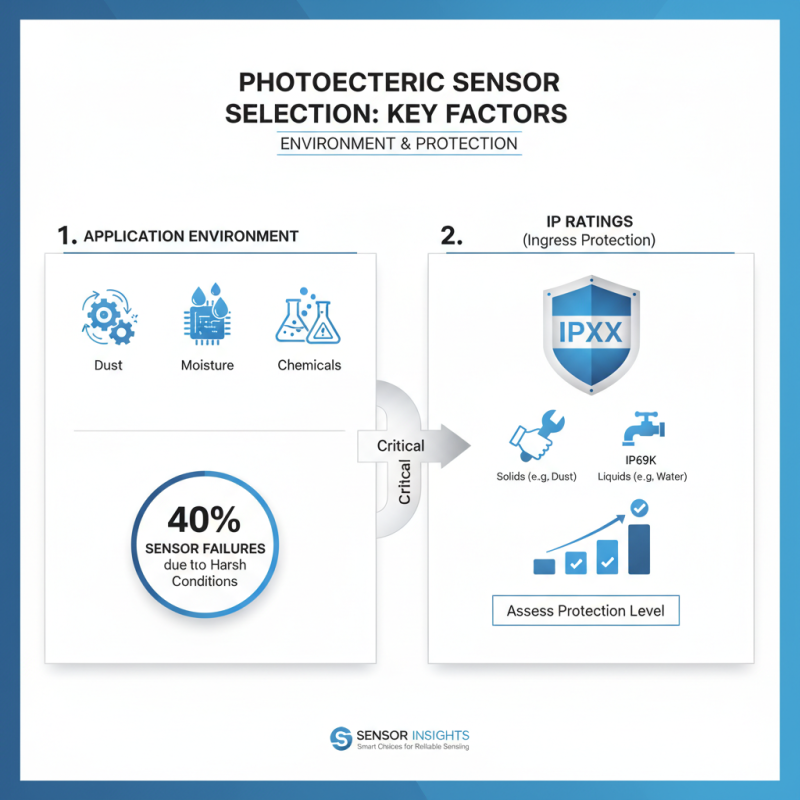
When selecting a photoelectric sensor, several critical factors come into play. Understanding the application environment is vital. Sensors are often exposed to dust, moisture, or chemicals. According to industry reports, up to 40% of sensor failures result from harsh conditions. IP ratings, which indicate the level of protection against these elements, should be carefully assessed.
The type of photoelectric sensor is also essential. There are four main types: through-beam, reflective, retro-reflective, and diffuse. Each type serves different purposes. For instance, through-beam sensors offer a longer range but require careful alignment. Reflective sensors provide more versatility but might be prone to interference from background objects. Choosing the right type can reduce the risk of misalignment, which accounts for about 30% of operational errors.
Lastly, consider the sensing distance. This factor greatly impacts the sensor’s performance in real-world conditions. Reports show that inadequate distance specifications lead to performance issues in over 25% of installations. Therefore, understanding application-specific distances can guide the selection process, ensuring the sensor operates effectively in its intended setting.
Types of Photoelectric Sensors and Their Specific Applications
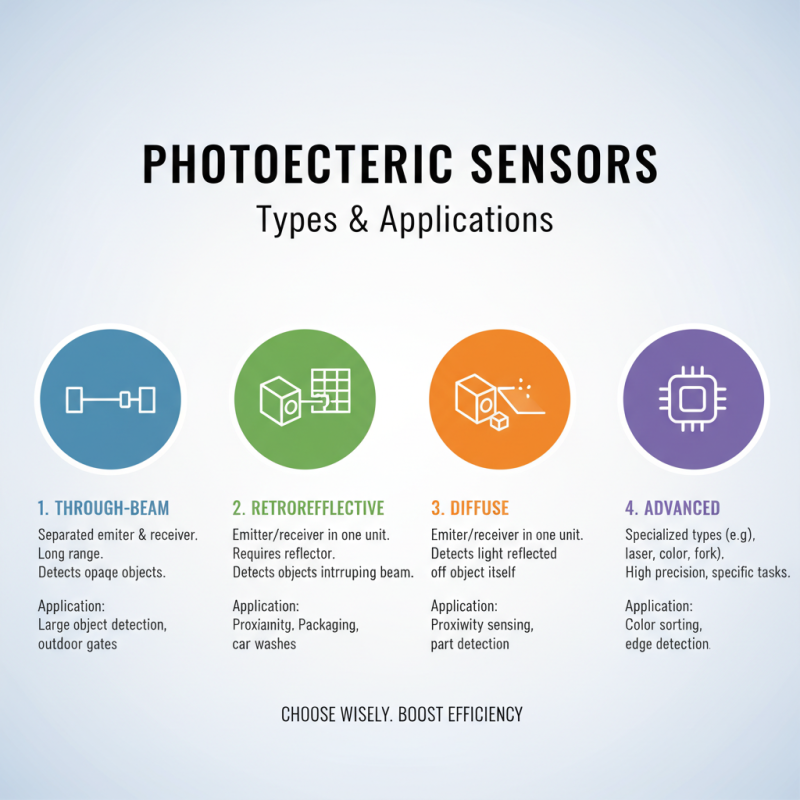
Selecting the right photoelectric sensor is crucial for various applications. These sensors primarily fall into four types: through-beam, retroreflective, diffuse, and advanced. Each type has unique characteristics that suit specific environments and needs.
Through-beam sensors are ideal for long-range detection. They send light beams directly from the emitter to the receiver. This design is effective in dirty or dusty conditions. Retroreflective sensors, on the other hand, bounce light off a reflective surface. They work well when space is limited. Diffuse sensors can detect objects at shorter distances. They rely on the reflected light from the item being sensed. Applications range from packaging to assembly lines.
Advanced photoelectric sensors include features like background suppression and adjustable sensitivity. These sensors are beneficial in complex settings. They can differentiate between multiple objects and minimize false readings. However, choosing the right one can be tricky. Often, their capabilities may not fully align with operational needs. Therefore, careful evaluation is essential to avoid costly mistakes.
Understanding the Sensing Distance and Environmental Conditions
When selecting a photoelectric sensor, understanding the sensing distance is crucial. Sensing distance determines how far the sensor can effectively detect objects. For instance, many sensors operate within a range of 0.1 to 10 meters. Depending on your application, this range can significantly impact system efficiency.
Environmental conditions play a vital role as well. Extreme temperatures, dust, or moisture can affect sensor performance. According to industry reports, over 30% of sensor failures occur due to unsuitable environmental factors. It's essential to review IP ratings. An IP67 rating indicates protection against dust and water, making it suitable for industrial environments.
Consider the mounting location and angle too. Misalignment can lead to reduced effectiveness. If a sensor is placed too far from the target, it may not detect it accurately. Conducting field tests can reveal potential issues. Many experts suggest running preliminary assessments to ensure compatibility with your specific conditions.
Key Specifications: Response Time and Output Options
Choosing the right photoelectric sensor involves understanding key specifications, particularly response time and output options. Response time measures how quickly a sensor can detect an object and send a signal. In fast-paced environments, such as manufacturing lines, a quicker response is crucial. Consider how your application needs react to moving objects. Sensors with a response time of less than 2 milliseconds are often preferred for these applications.
In terms of output options, photoelectric sensors generally provide either binary or analog outputs. Binary outputs deliver a simple ON/OFF signal, while analog outputs provide continuous data about the distance or intensity detected. If your system requires precise measurements, an analog output is essential. For simpler applications, binary outputs might suffice.
Tips: Assess the environment where the sensor will be installed. Factors like dust, humidity, and temperature can affect performance. Ensure you choose a sensor suitable for such conditions. Also, thoroughly test the sensors before full deployment. Small variances in response time can lead to significant differences in operation. Always reflect on past experiences and learn from them. Selecting a photoelectric sensor isn't just technical; intuition plays a part too.
How to Choose the Right Photoelectric Sensor for Your Application?
| Sensor Type |
Response Time (ms) |
Output Options |
Detection Range (m) |
Operating Voltage (V) |
| Through-beam |
0.5 |
NPN/PNP |
0.2 - 20 |
10 - 30 |
| Retro-reflective |
1.0 |
NPN/PNP/Relay |
0.1 - 15 |
12 - 24 |
| Diffuse |
2.0 |
NPN/PNP |
0.05 - 5 |
24 |
| Photoelectric Switch |
0.8 |
NPN/PNP/Analog |
0.5 - 10 |
24 |
Industry Standards and Certifications for Photoelectric Sensors
When selecting photoelectric sensors, it is essential to consider industry standards and certifications. Standards like IEC, NEMA, and ISO ensure these sensors meet safety and performance criteria. Compliance indicates reliability and helps users avoid costly mistakes. Ignoring these aspects may lead to inadequate performance or even safety hazards.
Certifications can vary by region and application. Some sensors are designed for harsh environments, while others are specific to safety applications. It’s crucial to match the sensor's specifications with the application requirements. Consider how the sensor will be used. Installation, maintenance, and environmental factors all come into play. Sensors with inadequate certification may not perform as expected.
Evaluating certifications can be complicated. Sometimes, manufacturers may not provide clear documentation. This lack of clarity can lead to doubts about reliability. Explore available options and research the sensors thoroughly. Engaging with industry experts can offer invaluable insights. Validating choices through peer discussions may highlight potential issues and confirm decisions.