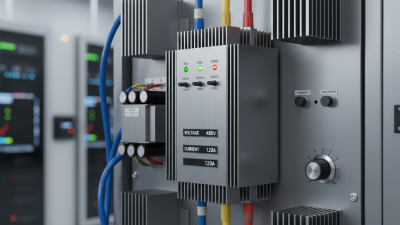
Why Choose the Right Power Controller for Your Needs?
In today's rapidly evolving energy landscape, selecting the appropriate Power Controller is vital for optimizing electrical systems. According to the International Energy Agency (IEA), efficient power management can lead to a 30% reduction in energy costs. This emphasizes the necessity of choosing a controller that meets specific operational needs.
Power Controllers are essential for regulating electricity flow, ensuring stability, and enhancing equipment longevity. As industries shift towards more sustainable practices, the demand for reliable power management solutions is increasing. For instance, the market for power controllers is projected to grow at a CAGR of 6.5% from 2022 to 2029, reflecting their critical role in energy management.
However, not all Power Controllers provide the same functionality. Selecting the wrong controller can lead to inefficiencies and increased operational risks. Companies may face unexpected downtime and financial losses. Thus, a thorough understanding of one’s unique requirements is essential. Thoughtful consideration is key to making a well-informed decision that aligns with both efficiency and reliability in power management.

Understanding Power Controller Basics and Functions
When selecting the right power controller, it's essential to grasp the basic functions and features they provide. Power controllers manage energy flow efficiently, ensuring systems operate smoothly. According to the International Energy Agency, up to 30% of energy is wasted in industrial settings. A suitable power controller minimizes this waste, optimizing performance while reducing costs.
Understanding the types of power controllers available is critical. They range from simple analog controllers to complex digital ones with advanced features. Each comes with varying capabilities. For example, digital controllers often offer enhanced data analytics. However, they may involve a steeper learning curve. Choosing the right type depends on specific application needs.
Another aspect to consider is compatibility. A power controller must integrate seamlessly with existing systems. Mismatches can lead to operational failures or increased energy costs. A survey by the Energy Management Association found that improper integration leads to 20% of businesses facing energy management issues. Evaluating compatibility is non-negotiable, yet it’s a commonly overlooked factor. Making informed choices can dramatically impact efficiency and effectiveness in energy management.
Identifying Your Specific Power Needs and Applications
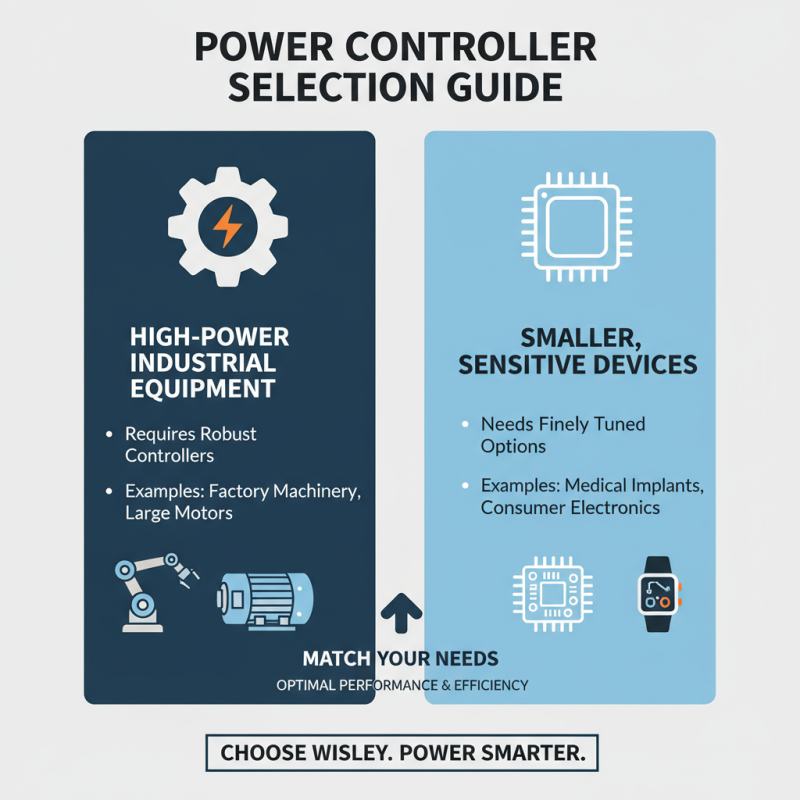
Choosing the right power controller involves understanding your specific power needs and applications. Different devices and systems require different levels of power. The right controller should match these requirements effectively. For example, high-power industrial equipment needs robust controllers, while smaller, sensitive devices might require finely tuned options.
Consider the operational environment as well. Controllers can vary in durability and functionality based on where they are used. Outdoor applications may need weather-resistant features. In contrast, indoor settings might prioritize compactness and efficiency. It’s crucial to evaluate voltage and current ratings, as mismatched configurations can lead to performance issues. Analyze past experiences with power management. Not all solutions work universally.
Explore the compatibility of the power controller with existing systems. Systems can fail if the controller does not integrate well with other components. This oversight often leads to frustrations. Identify gaps in knowledge. Engaging experts or consulting reliable resources can enhance decision-making. Understanding these elements creates a clearer pathway to selecting the right power controller tailored specifically to your needs.
Comparing Different Types of Power Controllers Available
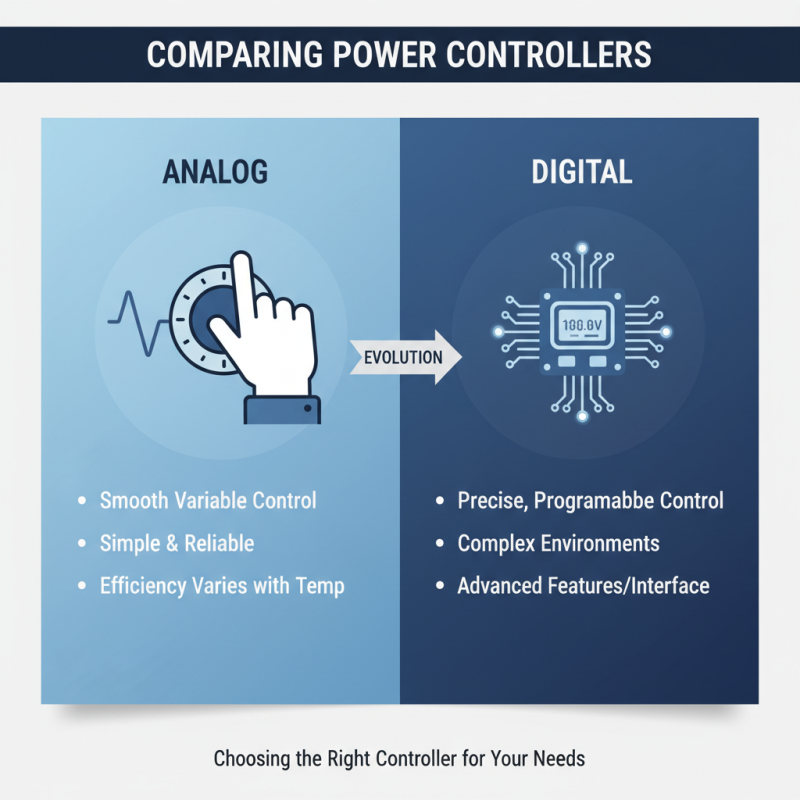
When selecting a power controller, it is essential to understand the various types available. Each type has unique features and purposes. For instance, analog power controllers allow for smooth variable control. They are often simple to use and reliable. However, their efficiency can be affected by temperature changes. Digital power controllers, on the other hand, provide precise control. They often include programmable settings and interfaces. This makes them suitable for more complex environments.
Another type includes relay-based controllers. These are designed for on-off applications. They work well with resistive loads but may not perform optimally with inductive loads. Additionally, there are PWM (Pulse Width Modulation) controllers. They excel in energy efficiency, making them a good choice for renewable energy applications. However, the complexity of installation and configuration can be a downside for inexperienced users.
Choosing the right controller requires careful consideration. Think about your specific needs and environment. It may be beneficial to consult with a professional. This could help clarify the best options available. Remember, selecting a power controller is a balance between functionality and user experience. Each choice has its pros and cons that need to be weighed carefully.
Evaluating Key Features and Specifications for Selection
Choosing the right power controller requires careful evaluation of features and specifications.
Begin by considering voltage and current ratings.
These specs determine how much power the controller can efficiently handle. Matching the power controller to your specific equipment
is crucial. A mismatch can lead to failures or reduced performance.
Look for key features that suit your application. For instance, consider temperature control and
safety mechanisms. These features enhance reliability and protect your equipment from damage.
Additionally, assess the controller’s user interface. A clear and intuitive interface can simplify operation and troubleshooting.
Sometimes, specifications can seem overwhelming. Not all features are necessary for every situation.
It’s essential to reflect on what you truly need.
Overloading on features can lead to confusion and unnecessary costs.
Take the time to understand your requirements before making a decision.
This will ensure you choose a power controller that truly fits your needs.
Making Informed Decisions: Cost vs. Performance Considerations
Choosing the right power controller is crucial for efficiency and performance. Many users face the dilemma of cost versus performance. According to a recent industry report, nearly 70% of companies prioritize cost when selecting power solutions. However, this often leads to underperformance in critical applications.
Performance and long-term savings are essential factors. A reliable power controller can optimize energy usage, reducing utility costs by as much as 25%. This statistic underlines the importance of making informed decisions that consider both upfront investment and ongoing operational efficiency. Cheaper options may not provide the expected reliability, resulting in costly downtime.
Real-world application shows diverse needs across industries. Data from a leading energy management study reveals that businesses that invest in high-performance controllers enjoy an ROI of 15-20% within the first year. However, improper evaluation may lead to regrettable choices. Users must balance initial costs with potential savings and performance enhancements. Avoiding this balance can lead to reflecting on lost opportunities for improvement.
Power Controller Performance vs. Cost Analysis