How to Choose the Right Photoelectric Sensor for Your Needs?
When it comes to industrial automation, choosing the right Photoelectric Sensor is crucial. As noted by Dr. Emily Carter, a leading expert in sensor technology, “Selecting the right sensor can make or break the efficiency of a system.” This highlights the importance of understanding your specific needs. The Photoelectric Sensor industry offers a variety of options, each designed for different applications.
Key factors must be considered when selecting a Photoelectric Sensor. These include sensing distance, target size, and environmental conditions. Each application may demand different functionalities. For instance, sensors used in harsh environments require more robust features. Understanding these nuances can be challenging yet vital.
Moreover, it's worth reflecting on the trade-offs involved. A sensor that excels in one area might lack in another. This complexity means that careful evaluation is needed. The decision can’t be taken lightly, as the impact of this choice reaches far beyond the initial purchase. Navigating this landscape requires both knowledge and experience. It’s essential to consult with experts in the field to ensure the right decision is made.
Understanding the Basics of Photoelectric Sensors and Their Types
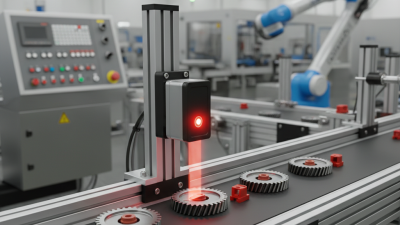
Photoelectric sensors are vital in various industries. They detect objects and measure distances without direct contact. Understanding their basics requires knowing different types, including through-beam, retro-reflective, and diffuse sensors. Each has specific applications suited to particular environments.
Through-beam sensors work with a light source and receiver. They offer high reliability and are effective in long-range detection. Retro-reflective sensors bounce light off a reflector. This setup is great for shorter distances but may face challenges in reflective surfaces. Diffuse sensors detect light reflected from the object itself. They are versatile but can struggle with darker or transparent materials.
Choosing the right sensor involves considering your specific application. Factors like the detection distance, environmental conditions, and object characteristics play crucial roles. It's essential to reflect on the limitations of each type. For example, the angle of incidence can affect detection accuracy. Understanding these aspects ensures you select a photoelectric sensor that meets your needs effectively.
How to Choose the Right Photoelectric Sensor for Your Needs?
| Sensor Type |
Operating Principle |
Detection Range |
Key Features |
Typical Applications |
| Through-beam Sensors |
Emitter and receiver are separate |
Up to 15 meters |
High sensitivity, long range |
Conveyor systems, entrance monitoring |
| Reflex Sensors |
Emitter and receiver in one unit with reflector |
Up to 10 meters |
Compact design, simple installation |
Packaging, material handling |
| Diffused Sensors |
Reflects light from the object directly |
Up to 2 meters |
Cost-effective, versatile |
Automated assembly lines, sorting systems |
| Photoelectric Tubes |
Uses a photoconductive sensor element |
Varies based on specific model |
High response speed, adjustable sensitivity |
Textile industry, medical equipment |
Key Parameters to Consider When Selecting a Photoelectric Sensor
When selecting a photoelectric sensor, understanding key parameters is crucial. Sensitivity, response time, and detection range are essential factors. Sensitivity determines how well the sensor detects objects under various environmental conditions. Reports indicate that sensitivity can differ significantly across different types of sensors, affecting their performance in industrial applications.
The response time is equally vital. A faster response allows for efficient operation in dynamic environments. Current industry research suggests that sensors with a response time under 1 millisecond are ideal for fast-moving applications. On the other hand, those working with static objects may prioritize other features.
**Tip:** Consider the implementation environment. Heavy dust or moisture can impede performance, particularly with certain sensor types.
Detection range involves understanding how far the sensor can accurately detect an object. For various applications, choosing the appropriate range can enhance reliability. Some sensors work effectively over distances of several meters, while others function best in close proximity. It’s essential to analyze real-world scenarios to ensure the selected sensor meets specific operational needs.
**Tip:** Always assess the installation space. Sometimes, the physical setup may present unique challenges that could affect sensor performance.
Photoelectric Sensor Key Parameters Comparison
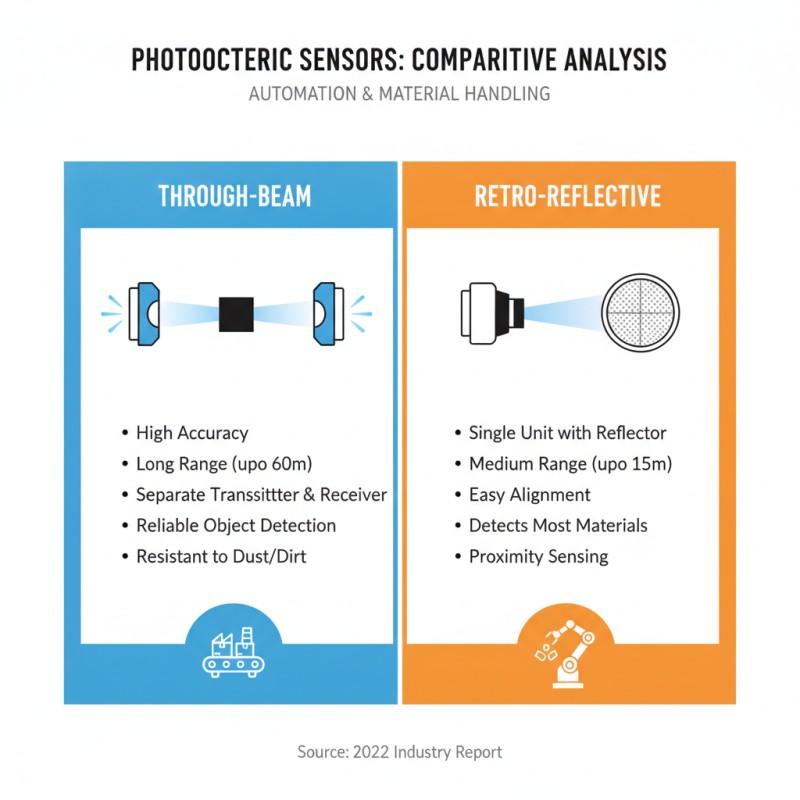
Comparative Analysis of Sensing Technologies: Through-beam vs. Retro-reflective
Photoelectric sensors play a crucial role in automation and material handling. Understanding the differences between through-beam and retro-reflective sensors can enhance decision-making. According to a 2022 industry report, through-beam sensors provide high accuracy and long-range detection capabilities. They consist of a transmitter and receiver, creating a light beam. This design minimizes false triggers from ambient light and obstacles.
Conversely, retro-reflective sensors are versatile and compact. They use a reflective surface to bounce the light back to the sensor. While they are easier to install, they may struggle with extreme environmental factors. Reports indicate that retro-reflective sensors are popular for applications requiring quick response times and lower costs. However, they may not perform as reliably in dusty or reflective conditions.
Consider the specific environment when choosing a sensor. If precision is non-negotiable, through-beam sensors may be the better option. In locations where space is limited, or budget constraints exist, retro-reflective sensors may suffice. Balancing performance against installation challenges remains a critical aspect of sensor selection. Addressing potential shortcomings in these technologies ensures optimal application success.
Application-Specific Requirements for Photoelectric Sensors in Industry
When selecting a photoelectric sensor for industrial applications, understanding specific requirements is crucial. Different environments necessitate different sensor types. For instance, in dusty or humid settings, IP67-rated sensors are essential to ensure durability. According to recent industry reports, over 40% of sensor failures occur due to insufficient environmental protections.
The sensing distance is also key. Short-range sensors work well in compact spaces. However, applications requiring longer detection distances may need more advanced technology. Reports indicate that 25% of companies face operational issues due to improper sensor range selection. Additionally, underestimating response time can lead to bottlenecks in production. Many processes require sensors that respond in under 1 millisecond for optimal performance.
Reflecting on these factors can prevent costly errors. Many industries overlook specific application needs during the selection process. This has led to over 15% of unplanned downtime attributed to sensor-related failures. Understanding the unique conditions of your application is vital for long-term success. In conclusion, a well-informed choice can significantly enhance productivity and reduce unexpected challenges.
Evaluating Cost-Effectiveness and Performance Metrics of Sensors
When selecting a photoelectric sensor, cost-effectiveness and performance metrics are crucial. Industry reports indicate that approximately 30% of maintenance costs in automation can be attributed to sensor failures. Choosing the right sensor can significantly reduce these expenses.
Performance metrics should include detection range, response time, and environmental tolerance. Many sensors offer a detection range from 30mm to over 10 meters. However, selecting a sensor with the perfect range for specific applications is often overlooked. A slower response time can lead to inefficiencies, affecting productivity.
Cost-effectiveness is not just about the initial purchase price. Long-term operational costs matter too. Some users focus solely on upfront costs, ignoring the potential savings from reduced downtime. An improperly chosen sensor might save money now but could sacrifice reliability, leading to higher costs later. Reflecting on the balance between upfront costs and long-term savings is essential for making an informed decision.